Cart 0
No products in the cart.
See my offer in the shop :)
Popular


Family law is the most common topic on my blog. But this is not the only area of law I cover. I also handle several cases related to franking credits. I would like to dedicate today's entry to the topic of securing a claim in a franking credit case.
Franc loans has been a very popular topic lately, and it is becoming more and more common to hear that the courts are taking the side of the francophiles and conceding to them in their disputes with the banks. Franc loans were popular just over a decade ago, during the real estate boom, when housing prices were similar to today - with much lower wages. At the beginning franking credits were very attractive to borrowers, as customers paid lower instalments than those who took out a contract in zloty. The situation changed with the change of the the exchange rate of the Swiss franc. Instalments franking credits have gone up sharply and borrowers are looking for a way to free themselves from the CHF loan.
If you are a so-called. “franking”, which means you have loan in Swiss francs and you are wondering whether it is worth going to court with your case, then I invite you to read today's post, as well as the post I wrote for the Women's Finance.
Precautionary measures is a legal solution to protect the claimant's interests in legal proceedings. As proceedings can last for many years, and during this time the debtor may try to obstruct a future judgment, the claimant has a tool to protect him against this. There are various forms of security for action depending on the case in question. This could be the seizure of a certain amount in the debtor's bank account, the imposition of a prohibition on the disposal of real estate, and in the franking cases most frequently encountered is the suspension of the obligation to repay loan instalments.
I recently had the opportunity to bring a claim to court for annul agreement concerning franking credit. According to our expert's calculations, the total of all payments made by my clients already exceeds the amount of credit, which had been disbursed to them by the bank. For this reason, the lawsuit also included a request to stop the plaintiffs' obligation to make loan repayments in the amount and on the dates described in the agreement and to prohibit the bank from terminating the agreement. Given that franking credit agreement may prove to be invalid, it is in the interest of borrowers is to stop making further instalments.
The position of my clients was shared by Warsaw Regional Court, which is hearing the case.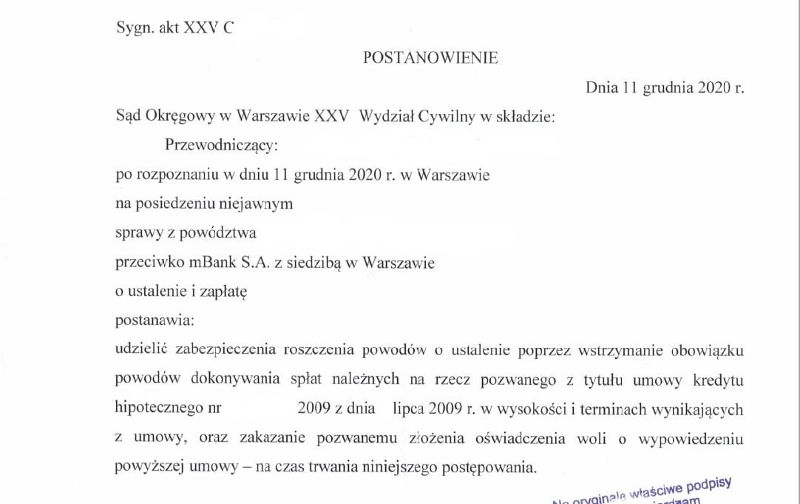
The order is not yet final, the bank has filed a motion to justify it and will probably also file a complaint. However, the wording of the statement of reasons for this order contains several important statements. The court stated that:
At this stage of the proceedings, the court found plaintiffs' claims to be plausible as to, inter alia, the following. loan amount the recoverable amount is not strictly defined in the contract and that detailed and objective rules for its determination are not indicated in the contract.
(...), in the Tribunal's view, continuing to provide a benefit which, at this stage of the proceedings, would have to be regarded as is not based on a contract, would lead to an unjustified burden on the plaintiffs and unjust enrichment of the defendant, unjustifiably increasing the scale of the necessary (if the contract is declared invalid) settlement between the parties. (...) it is therefore not in the legitimate interest of the claimants to continue to implement the credit agreement, and especially the repayment of loan instalments from a contract that can be declared absolutely void. The purpose of an action for annul This is because the aim is to bring about a situation in which the plaintiffs do not have to repay the loan at all. It is therefore inexpedient for them to repay the loan in the course of this litigation.
What does this mean for my clients? Well, it means that they do not have to make any further repayments during the course of the legal proceedings until they have reached a final decision. loan instalments.
Orders granting security claims for cancellation of a franking credit are maturing with increasing frequency. Obtaining such collateral is a positive signal for the borrowers, as in the court's view his claims are plausible. Of course, there is a risk that, despite the security being granted, ultimately borrower will lose, it all depends on the circumstances of the particular case.
And what can be won suing the bank? In the event that credit agreement in Swiss francs is invalid, there is, in effect, a free credit. The parties will have to account for each other's performance, which in simple terms means that borrower will have to pay back to the bank the amount of capital (without interest), while the bank will have to give back all the payments that have been made by the borrower. Thus, the game is worth the candle.
If you have loan in Swiss francs and you are considering whether to sue the bank, contact me! After analysing your case, I will present you with options and the way forward.

How much does a divorce cost in 2026? The court fee on a petition is £600 - but this is often just the start of the expenses. Find out what goes into the total cost of a divorce case: adjudication of guilt, division of property, Krakow lawyer's fees and when part of the fee goes back to the plaintiff.

Why do you need a lawyer in a family case and not ChatGPT?
 Polish Polish
  English
 Spanish